Sanrio Co., Ltd. (サンリオ Sanrio) is a multi-billiondollar Japanese entertainment company that heavily focuses on the kawaii popular culture known in that country (and became its image). Headquartered in the Ōsaki district of Shinagawa, Tokyo, Japan, it creates a wide range of designs and characters mostly based on cute and/or pure-hearted anthropomorphic animals (with generally basic appearances), and sells and licenses various products branded with these characters. These products include stationery, school supplies, gifts, accessories, and much more. Shintaro Tsuji is the founder of Sanrio and he continues to work at the company to this day despite being age 98 as of February 2026. Its main slogan is "Small Gift, Big Smile". According to Shintaro himself, the purpose of Sanrio's founding is to create a peaceful culture and to help people befriend each other. He was inspired to start the now-beloved company after experiencing the hardships of World War II at the time and had a lonely childhood.
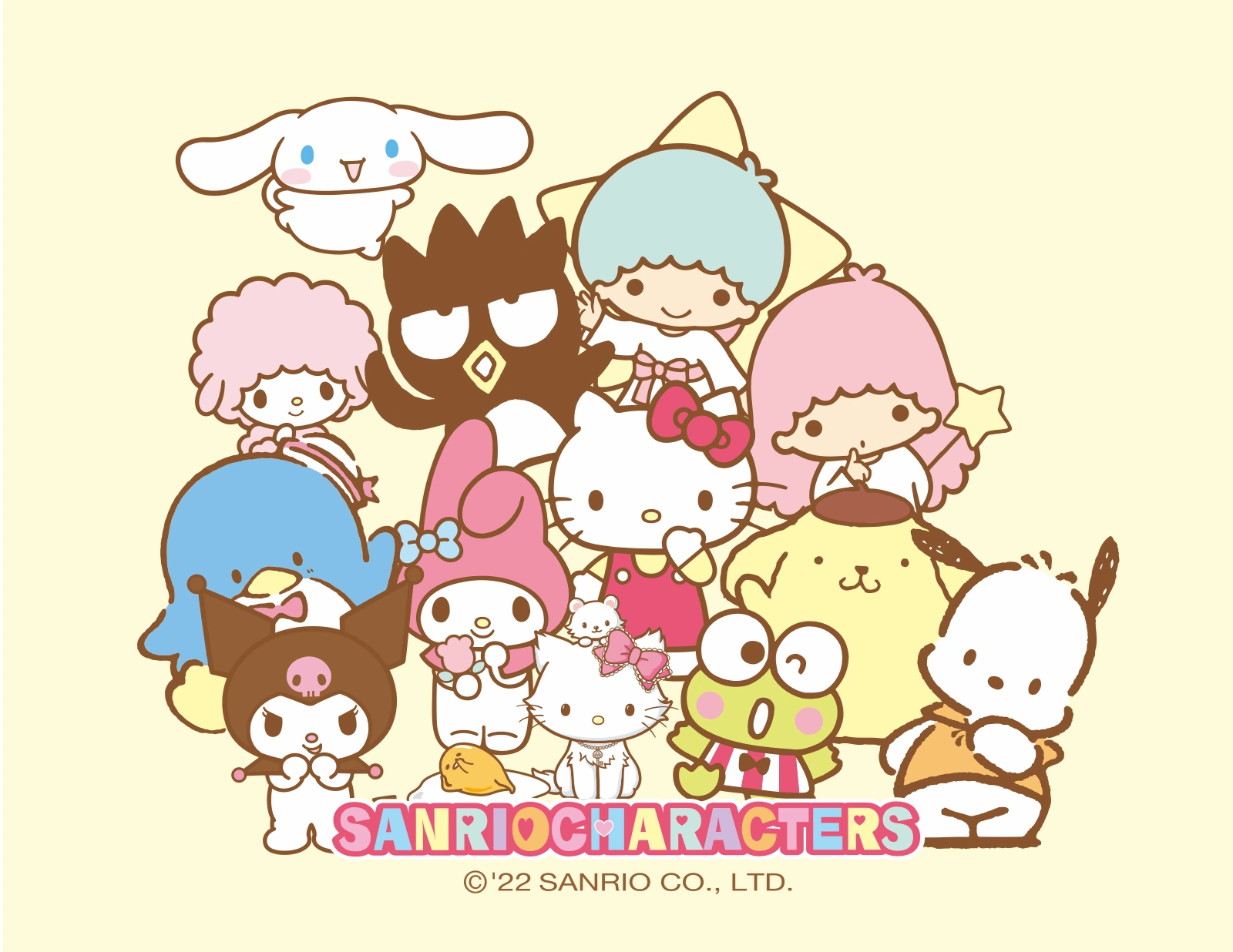
A group of Sanrio's well-known characters, consisting of Cinnamoroll, Little Twin Stars, My Sweet Piano, Bad Badtz-Maru, Hello Kitty (mascot), Tuxedo Sam, Kuromi, My Melody, Gudetama, Charmmy Kitty, Keroppi, Pompompurin, and Pochacco
.
Though the company itself is globally famous for its many iconic characters such as My Melody, Cinnamoroll, Kuromi, Keroppi and more, Sanrio's best-known is Hello Kitty, a white cat with blue overalls and yellow shirt wearing a red bow but normally has no mouth, and is its longtime mascot; she remains one of the most successful marketing brands in the world. Despite Sanrio had been selling merchandise beginning in the 1970s, it would kickstart a major media franchise based on Kitty and her friends since the mid-1980s known as Hello Kitty - the company's flagship series. A separate but related series, Beatcats, was produced in 2020.
Besides selling their famed character goods, Sanrio also takes part in movie production and publishing. They also participate in the fast food industry, running a franchise of Kentucky Fired Chicken in Saitama. The company also owns the rights to the famed Peanuts characters in Japan. Sanrio in addition has an animatronics company branch called Kokoro Company, Ltd. ("Kokoro" being the Japanese word for "heart"), best known for the android, Actroid.
Sanrio is the largest greeting card manufacturer in Japan. In 2002, they began a joint business venture with Disney for their greeting cards. In addition, Sanrio hosts two theme parks in Japan as well, Sanrio Puroland in Tama, Tokyo, and Harmonyland in Hiji, Ōita, Kyūshū.
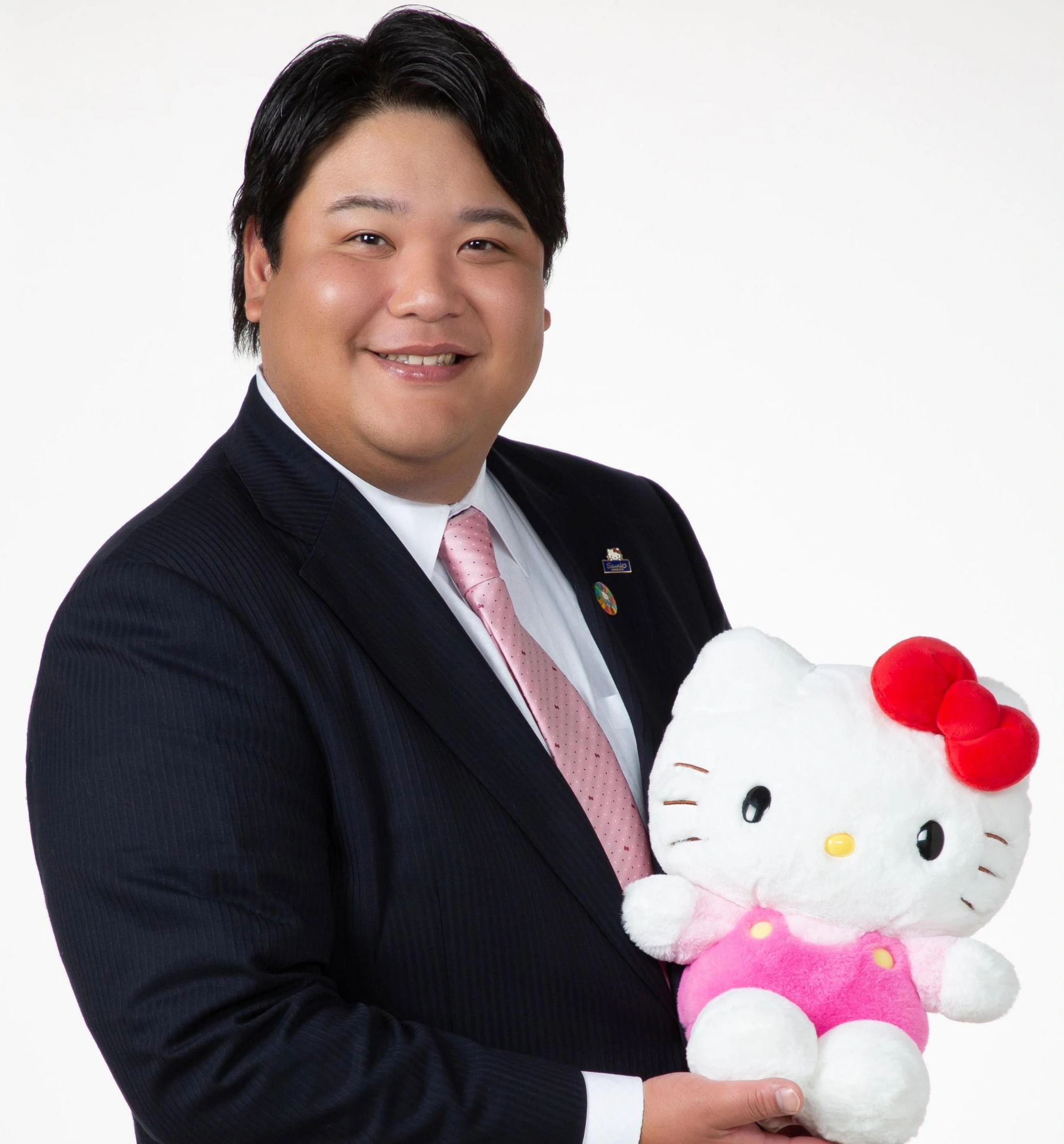
Tomokuni Tsuji, the current president of Sanrio
Tomokuni Tsuji, the grandson of Shintaro Tsuji, is the current chief executive of Sanrio since 2020, when Shintaro himself announces his retirement as CEO after working as such for a very long 60 years but remain as its chairman. As Tomokuni was only 31 when he took the position, he would also become the youngest main executive for a Japanese company. When asked about the characters, Tomokuni stated "Since I was born (in 1989), I was surrounded not only by Hello Kitty but all of the Sanrio characters, so I literally grew up with them. There was not a day when I didn’t see Hello Kitty.” During the mascot's 50th anniversary in 2024, he also claims it is very difficult to point out the single reason for Hello Kitty's phenomenal appeal and the longevity of the fandom, suggesting even Sanrio itself has no idea. "We’re amazed. To develop a character that sustains for 50 years is not an easy thing.”
History
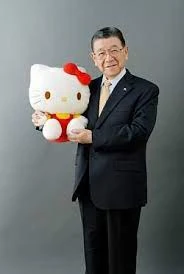
Shintaro Tsuji, the founder and former president/CEO of Sanrio
The original Sanrio logo from 1973 to 1997
Sanrio was founded by Shintaro Tsuji as the Yamanashi Silk Company in 1960, using ¥1 million in capital (equal to about ¥6,217,822 or $39,752 in 2025). The company, then a textile, produced a line of character merchandise around gift-giving occasions. It wasn't until 1973 that the company was officially established under the name "Sanrio." The word Sanrio comes from the Spanish words "san" (a shortened form of "santo"—"saint", "saintly", "sacred"—used in giving saints' names) and "río"("river"). At this point, in order to not pay royalty fees, Sanrio's international fame began its roots by creating original characters, starting with Coro Chan that year. However, this character wasn't successful.
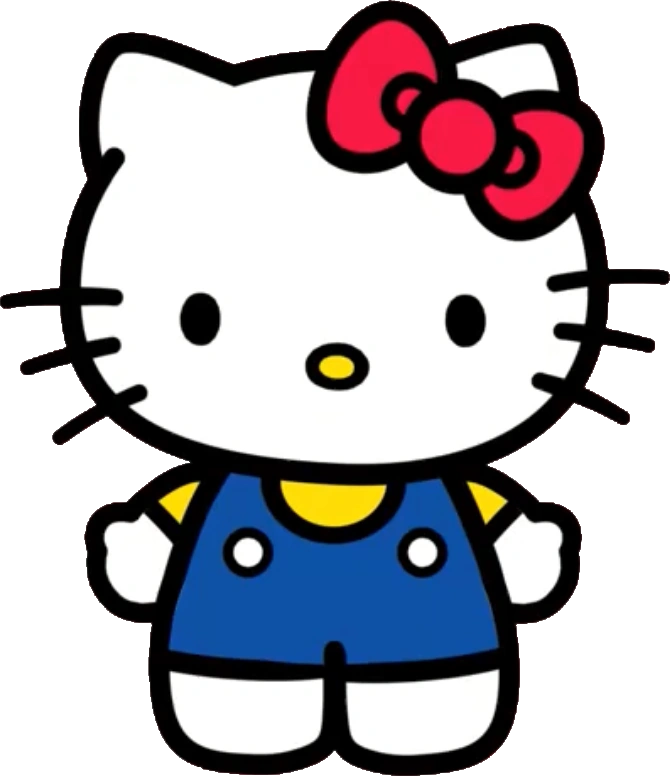
Since 1975, 15 years after its founding, Hello Kitty serves as Sanrio's mascot and main character
Hello Kitty, their second character, was added in 1974 and released the following year, who would become a revolutionary hit, and immediately the company mascot and main protagonist of her long-running franchise since then. The very popular mouthless feline girl has had both peaks and drops in sales over the decades, but always has been the highest contributor to Sanrio's sales in general, and is currently one of the most widely recognized and important cultural icons of all-time. Other classic characters debuted during Sanrio's early history that would also become critically acclaimed in their own right include My Melody (1975), Little Twin Stars (1975), Tuxedo Sam (1979), Keroppi (1988) and Pochacco (1989). The Little Twins Stars in particular was also created by Shintaro Tsuji himself, while My Melody serves as Hello Kitty's best friend and arguably Sanrio's second most prominent character behind Kitty herself, making her likely the Hello Kitty series' deuteragonist.
As Sanrio's list of characters rapidly continue to grow, more notably popular characters emerged over the decades such as Badtz-Maru (1993), Chococat (1996), Pompompurin (1996), Cinnamoroll (2002), and Kuromi (2005). Sanrio constantly adds new characters to its lineup (up to three a year), so some of the older characters eventually phase out or even go into retirement (such as Fifi or Cathy). Some of Sanrio's other known but less iconic characters are Mimmy (Hello Kitty's twin sister), Charmmy Kitty (Hello Kitty's pet cat), Corocorokururin the hamster, Hangyodon, Usahana, Gudetama, Minna no Tabo, My Sweet Piano, Dear Daniel (Hello Kitty's boyfriend), and the Cinnamoangels. In total, Sanrio has produced over 450 characters today. Although the vast majority are protagonists or supporting characters, antagonists do exist, such as Kuromi (originally) and Lloromannic. Due to the friendly nature of Hello Kitty, however, such antagonists are usually (but not always) anti-villains. For a time, Osamu Tezuka's baby unicorn character Unico, who starred in two feature-length anime movies in the early 1980s, was also part of the Sanrio empire; however, the rights to Unico shifted to Tezuka's own company after Tezuka's death in 1989.
Sanrio was introduced to the United States in 1976, which helped greatly increase the company's boom during when its first mainline characters were new and also explaining the early copyright year of most merchandise and official media worldwide.
In late 2003, Sanrio won the "Top Brand with a Conscience" award from the Medinge Group of Sweden for its communication principles. The company has partnered with UNICEF since 1984.
Sanrio Inc., Sanrio's American subsidiary that produces most of the merchandise found in franchise boutiques, has its office in South San Francisco, California. Sanrio's first Western store opened in San Jose's Eastridge Mall. There are eighteen "flagship" locations across the country, and in 2005 Sanrio opened its first high-end boutique called Momoberry at Beverly Center in Los Angeles. In the Western Hemisphere, Sanrio character-branded products are sold in upwards of 13,000 locations including department, specialty, and national chain stores and over 85 Sanrio boutiques. In April 2010, the first and only Sanrio-licensed eatery (Sanrio Cafe) in the U.S. opened at Pearlridge's Downtown phase in Aiea, Hawaii.
In the year 2000, Sanrio had launched Sanrio Wave, a joint venture between Sanrio and an email service called Nifty to create a branch that provided a @kitty.sanrio.ne.jp email, and later on other online projects. These projects included a whole shop called Sanrio Character Planet in the Sanrio World Mall website, entirely original characters, and the first online Sanrio game, Sanrio World. Sanriowave was located in Hong Kong in China and most of their projects focused on Asia. Sanrio characters have been among the most wanted content requested by mobile content providers and telecom operators, as Sanriowave ended up as a good business opportunity.
In 2006, Sanriowave made a new branch with a joint venture with Typhoon Games and launched Sanrio Digital to expand its brand around the world, offering similar services to Sanriowave, like an online game, mobile games, and even an email through SanrioTown which funnily enough, had a Japanese version made by Sanriowave.
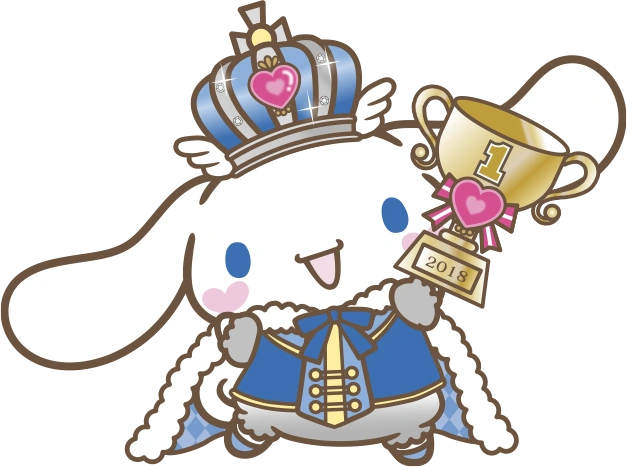
Cinnamoroll earned 1st place of the 2018 Sanrio ranking, which itself was his second out of seven annual wins so far
Since 1986, Sanrio has held the annual Sanrio Character Ranking poll where fans can vote on their favorite characters (with its most common winners being Hello Kitty and Cinnamoroll, with currently 14 and 7 wins, respectively). It began in the Strawberry Newspaper (ja:いちご新聞) published by Sanrio in Japan, but nowadays voting also takes place online. 2013 was an interesting event for the annual poll, as when characters reach certain positions that year, they would do special acts. In this case, as Hello Kitty was the winner, she went out and hugged everyone in Japan. As of April 2026, the current rankings, itself its 41st, is ongoing.
2010 was Sanrio's 50th anniversary. In conjunction with this, Build-A-Bear Workshop released limited edition stuffed toys of several Sanrio characters, including Hello Kitty, Chococat, My Melody and Keroppi.
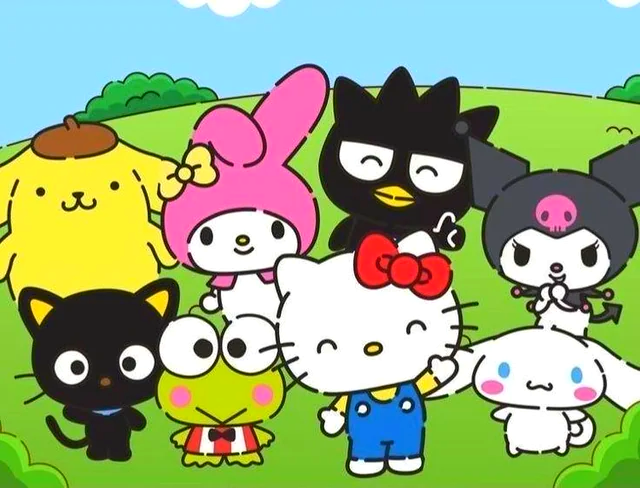
Hello Kitty and Friends Supercute Adventures, one of Sanrio's most acclaimed animated shows
Although Sanrio had created animated movies or shows as early as the 1970s, with multiple Hello Kitty related ones beginning in 1987, The Adventures of Hello Kitty & Friends in 2008 is the first ever made animation in 3D. This animation is licensed by Sanrio Digital and produced by Dream Cortex. The first season with 26 episodes premiered on select networks in Europe and Asia, including Hong Kong, beginning in the first quarter of 2008. Hello Kitty and Friends Supercute Adventures, released on YouTube in 2020 to celebrate Sanrio's 60th anniversary, is one of the company's most successful shows yet, and it stars nearly all of its flagship characters. Another hit, My Melody & Kuromi, was released in June 2025 to celebrate My Melody and Kuromi's respective 50th and 20th anniversaries. The majority of Sanrio's animations, however, are exclusive to Japan.
Sanriowave ended up being discontinued on January 1, 2019, but prior, on June 30, 2018, the ability to apply for an email was removed. Sanrio Digital lasted longer, but was mostly inactive after 2015, and was fully bought out by Animoca Brands on May 13, 2021, lying dormant for many years. The last update about Sanrio Digital was updating some of their apps, removing apps, and updating SanrioTown. SanrioTown was reported to have issues with logging in without tricky workarounds. But on November 1, 2023, the email itself was fully discontinued.
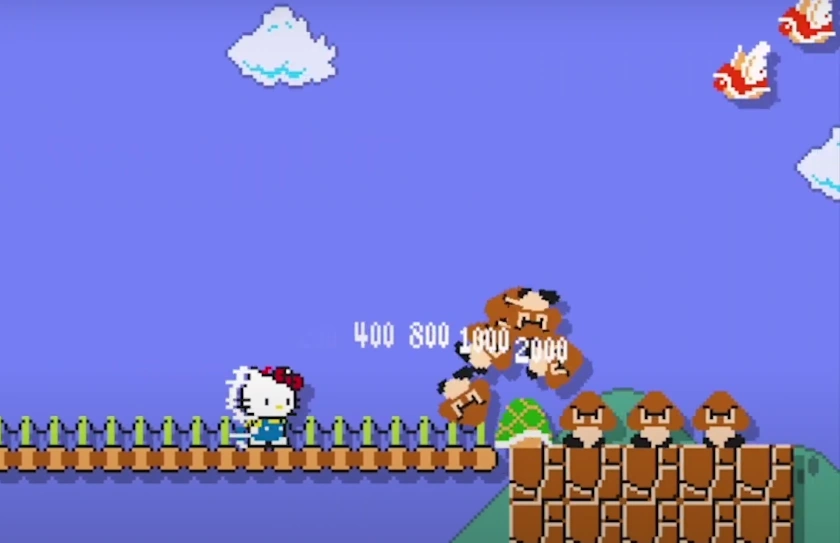
Hello Kitty's crossover appearance in Super Mario Maker from Nintendo's Mario franchise
Video games based on Sanrio first began in November 1990 with the release of Sanrio Carnival on the Famicom (NES) and Game Boy the following year. Since then, like the Hello Kitty animations/shows, although the majority of games and special edition content are exclusively released in Japan, some do make it overseas. The latest game yet is Hello Kitty and Friends: Freeze Tag Party, released in 2025 for the Nintendo Switch and Nintendo Switch 2. In recent years, Hello Kitty and a handful of her friends such as My Melody have appeared in other famous media such as Nintendo's Super Mario, Animal Crossing, Sega's Sonic the Hedgehog, and more in officially licensed crossovers or cameos.
Sanrio Characters
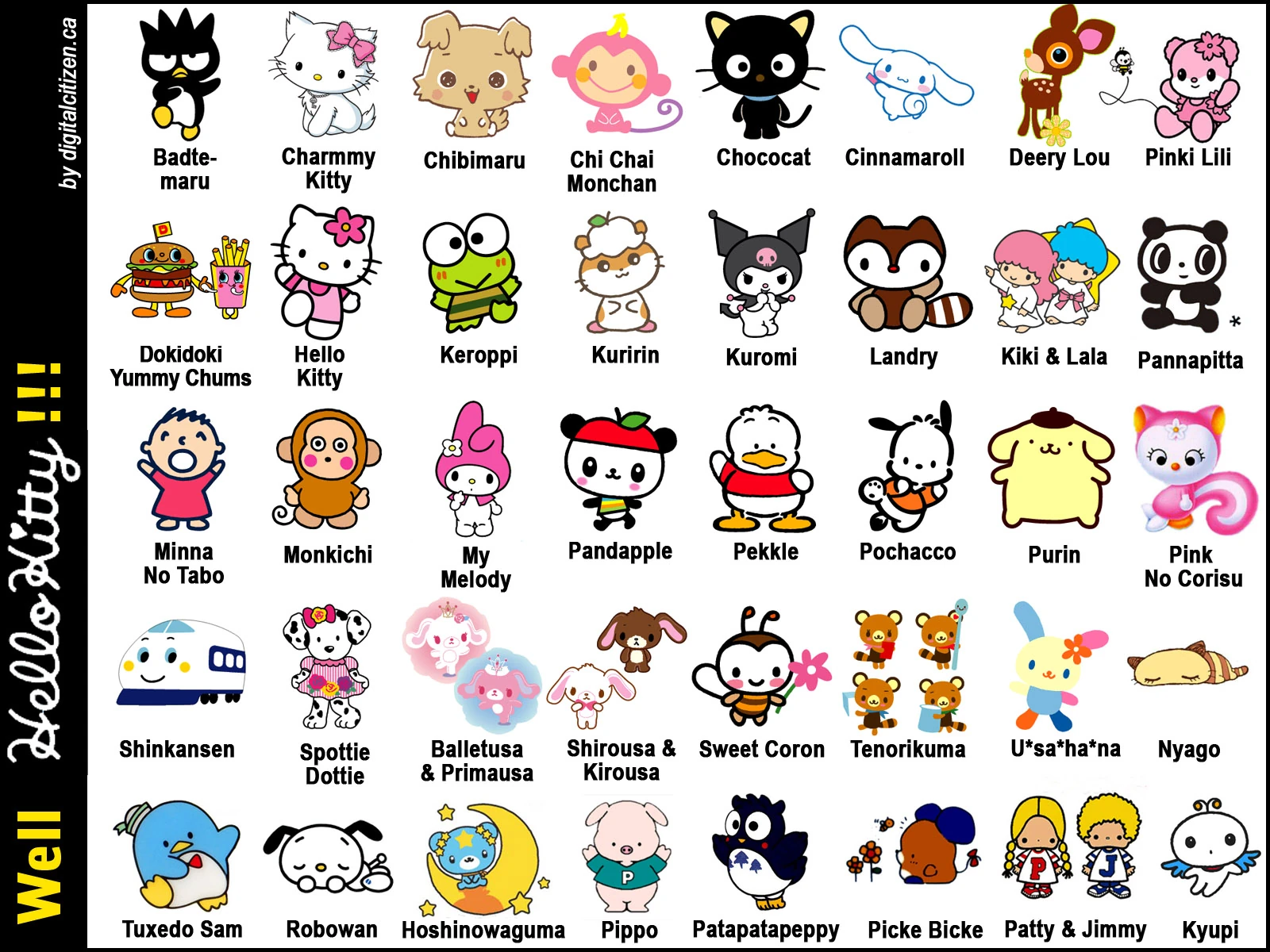
Sanrio's currently known characters
See the Sanrio Characters category or the List of Sanrio characters page.
Filmography
See the Movies category.
From 1977 to 1985, Sanrio produced the following movies through their Sanrio Films label:
- Little Jumbo (1977) (Chiisana Jumbo)
- Who Are the DeBolts? And Where Did They Get Nineteen Kids? (1977) —with Korty Films and Charles M. Schulz Inc.
- The Mouse and His Child (1977) (Oyaro Nezumi no Fushigina Tabi or The Wonderful Journey of the Mouse Family)
- Ringing Bell (1978) (Chirin no Suzu or Bell of Chirin or Ringing Bell)
- The Glacier Fox (1978) (Kita-Kitsune Monogatari or The Story of the Nothern Fox)
- Nutcracker Fantasy (1979) (Kurumiwari Ningyo or The Nutcracker)
- Unico: Black Cloud and White Feather (1979)
- Metamorphoses/Winds of Change (Sanrio) (1979) (Orpheus no Hoshi or Orpheus of the Star)
- A Tale of Africa (1980) (Afurika Monogatari)
- The Fantastic Adventures of Unico (1981) - with Tezuka Productions and Madhouse Studios
- The Sea Prince and the Fire Child (1981) (Sirius no Densetsu or Legend of Sirius)
- Don't Cry, It's Only Thunder (1981)
- The Ideon: A Contact (1982) - with Sunrise and Shochiku
- The Ideon: Be Invoked (1982) - with Sunrise
- Unico in the Island of Magic (1983) (Yuniko: Maho no Shima he) - with Tezuka Productions
- Oshin (1984)
- A Journey Through Fairyland (1985) (Yosei Florence or Florence the Fairy)
- Mouse Story: George and Gerald's Adventure (2007) (Nezumi Monogatari: George To Gerald no Bouken) - with Madhouse Studios
- Cinnamoroll: The Movie (2007) - with Madhouse Studios
- Jewelpet the Movie: Sweets Dance Princess (2012)—with Sega Toys and Studio Comet
- Onegai My Melody: Yu & Ai (2012)—with Studio Comet
After "A Journey Through Fairyland", Sanrio switched gears and started doing short films, OAVs, and TV shows based on their characters (Hello Kitty, etc.). In 2006, Sanrio announced they're going to do feature-length films again when they announced they were making 2 new movies: Nezumi Monogatari: George To Gerald no Bouken (Mouse Story: George and Gerald's Adventure), about mice living together, and Cinnamoroll: The Movie, about the character Cinnamoroll. The two movies were released as a double feature on December 22, 2007 and were expected to be released overseas.
An upcoming feature-length animated film featuring Hello Kitty by Warner Bros. is planned to be released on June 21, 2028. It is not yet known what its plot will be.
Publishing
Sanrio publishes many books featuring its own characters. Additionally, they publish art books (for instance, those by Keibun Ōta) and other books. Sanrio publishes their books in many different languages, including Japanese and English.
Further Reading
- Kinsella, Sharon. "CUTIES IN JAPAN", published in "Women Media and Consumption in Japan", Lise Skov & Brian Moeran eds., 1995
Gallery


Trivia
- When asked about why Hello Kitty is the mascot of Sanrio, founder and former president Shintaro Tsuji stated "I felt that the most important thing in your life is to have someone whom you can open up your heart to and talk about anything; to have many friends whom you can talk with your heart is the most blessed thing in your life. Then I asked myself how can you make friends -- in what way people can make a friend with those people. That is not just to avoid behaving, which makes people uncomfortable. But do something, which makes people happy. In this way people can make friends. For example, when people are ill, you can say something to them, or when people did something for you, you say "thank you" to them. For those kinds of occasions, you send a small present rather than an expensive gift. It is important to show your appreciation since you are able to make good friends in this way. This idea has formed as a business (Sanrio). As a result, Hello Kitty was created. Hello Kitty has become known among everybody and it means that people are becoming friends. I am pleased with this phenomenon."
- Shintaro also explained that Hello Kitty herself has a meaning of three messages: The first is you should be loved and be nice to others to be loved yourself, second, her signature red bow represents human connections and people should get along with each other, and lastly, the character not usually having a mouth is people needing to express with actions and not only by words.
- As of 2024, Sanrio's net worth is $4.72 billion.
- Alongside "Small Gift, Big Smile", Sanrio's secondary slogan is "One World, Connecting Smiles".

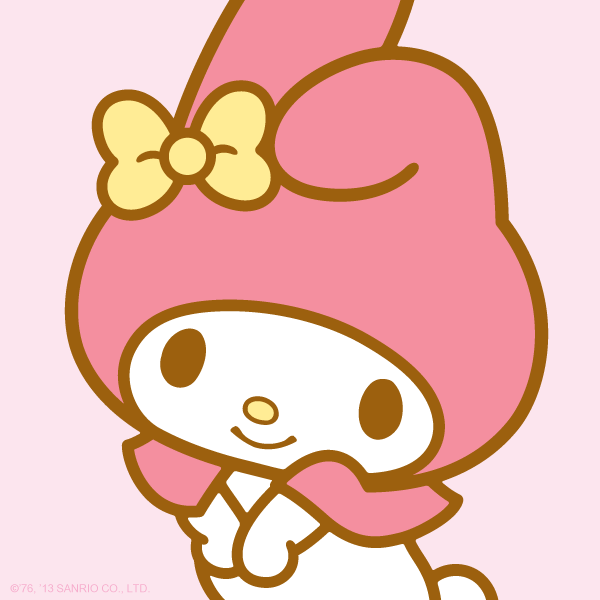
My Melody, Hello Kitty's best friend, has a similar beloved reaction among the kawaii community compared to Sanrio's main mascot, often placing second by fans
- Although never officially stated by Sanrio, My Melody, one of its earliest flagship characters, is often considered by fans to be the company's secondary mascot, due to her especially close friendship, paired appearances in and outside the Hello Kitty franchise, and immense popularity next to Hello Kitty.
- During Sanrio's earliest business days in the 1960s, the company once used Snoopy, one of the main characters of the popular Peanuts comic strip series to help promote it. However, they would soon lose the rights to him due to royalty fees, setting up the motion to create their own original characters since 1973. Snoopy in particular is the inspiration for Pochacco. He can also be found in the first Sanrio Character Rankings from the late 1980s.
- In Hello Kitty and Friends Supercute Adventures and Hello Kitty Island Adventure, My Melody uses Sanrio's primary slogan as her own for her shop.
- Shintaro's son, Kunihiko Tsuji, was at one point going to be the heir of Sanrio before his death in 2013, where it was soon given to his grandson Tomokuni, instead.
- Most of the mainline Sanrio characters are known to be officially stated at very small sizes ironically similar to that of a medium-sized plush, but is inconsistent in various artwork and other media, as in some cases they are depicted to be much larger.
- Most major media created by Sanrio are depicted in 2D. However, some in three-dimensional graphics exist, especially in recent years.
- The Hello Kitty series by Sanrio is one of the highest grossing media franchises of all-time, with a revenue of over $85 billion, surpassing Disney's Winnie the Pooh and Mickey Mouse, but only beaten by Nintendo's Pokémon series.
- One of the main reasons for the massive international appeal of Sanrio's characters is unlike most other popular ones from various different major franchises (such as Mario, Mickey Mouse, Sonic the Hedgehog, etc.), their designs are made with simplicity in mind and remain virtually unchanged since their debut, due to the kawaii culture.
- Despite being primarily associated with anthropomorphic animals, Sanrio's characters do include humans, albeit rarely.
- Real-world animals also co-exist with such characters, with a popular example being Charmmy Kitty, Hello Kitty's pet cat.
- In spite of Sanrio being widely known for its overall cute, family-friendly theme with a strong focus of friendship, rare cases of darker media exist, such as the 1978 movie Ringing Bell, which involves violence and death.
- In 2019, Sanrio was fined by the European Commission for 6.2 million euros (approx. 6.9 million U.S. dollars) for blocking cross-border sales of its licensed products.

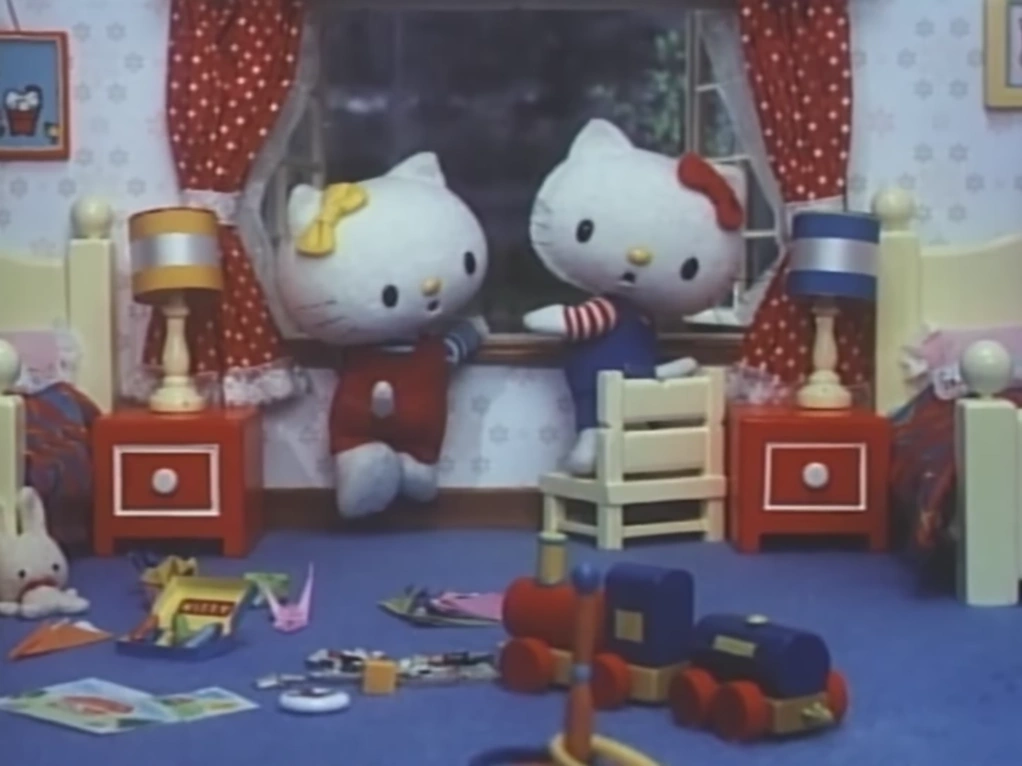
Kitty to Mimi no Atarashii Kasa, the very first Hello Kitty-related animation
- Although Hello Kitty's Furry Tale Theater in 1987 is widely believed to be the debut of the Hello Kitty animation series, a rather unknown Japan-exclusive stop-motion OVA called Kitty to Mimi no Atarashii Kasa exists as early as 1981. This would also be technically the first time Hello Kitty and Mimmy are depicted with visible mouths. Furry Tale Theater, however, is the first to reach a major audience.


Sources
- Sanrio on Wikipedia
- Sanrio Filmography on Wikipedia
- Sanrio's official English website
- Sanrio's official Japanese website
- Interactive Sanrio Character List
- A 1999 "interview" with classic Sanrio character My Melody
- Sanrio's Internet Community Site
- Sanrio Spotlight:Momoberry
- Momoberry's official website
- Sanrio Digital Website
- Dream Cortex Website
- VintageSanrio.com via Archive.org